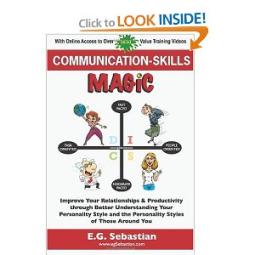

Get Communication Skills Magic Today! — $2595+ in “Thank You” Bonuses

Communication Skills Magic

Get an instant eDownload of your book (in Pdf. format) as soon as you place your order…

And as a thank you for ordering today,  you’ll receive $50+ value super cool bonus eBooks:

  • Cet instant access to Communication Skills Magic – eBook ($7.00 Value)
  • Instructional videos and audios, covering most topics in the book ($850.00 Value – log-in information available in the book on page 8 )
  • PowerPoint slides and basic work-sheets/handouts, so you can learn faster or teach it to others ($280.00 value — access information provided inside the book)
  • How to Overcome Your Fear of Public Speaking (27.00 Value)
  • 101 Romantic Ideas ($17.97 Value)
  • How to Read Body Language Like a Book , by E.G. Sebastian ($24.00 Value)
  • Wake’Em Up, by Tom Antion ($19.95 Value )
  • How to Improve Your Memory ($17.00 Value)
  • As a Man Thinketh, by James Alen
  • 101 Ways to Relive Stress ($14.95 Value)
  • How to Keep Your Children Safe from Online & Neighborhood Predetors ($14.95 Value)
  • Blogging 101 ($27.00)
  • Single’s Guide to Successful Dating ($19.95 Value)

eCourses

(Sign up to OUR autoresponder to get any of the following eCourses in your email inbox)

  • How to Use Social Media to Market Your Business ($37.00 Value)

To order, click on the book cover above, or Click Here!

100% 45-Days Money Back Guarantee!!!


You either absolutely love the book, or you can request a full refund – no questions asked!
[The Bonuses are still yours to keep, no matter what you decide]

To get the book, simply click on the book cover above, or click tye button below:
(you’ll instantly get access to the electronic version as well, in Pdf. form)

Communication Skills Magic – Soft Cover Book – $17.97
(Includes Sh. & Handling within the US)

If you’d rather invest only in the electronic/eBook version,  click on the button below

Communication Skills Magic - eBook - $7.00
(Yes, only $7.00! – I believe everyone should have access to this info!)

Got any questions regarding the above info? All questions will be answered!

How Successful are You in Your Relationships?

How Successful Are You in Your Relationships?

 When it comes to creating and maintaining successful relationships and effectively communicating with those around us, most of us dabble in the dark and communicate with others based on our instincts; which sometimes works and most lots of times we end up frustrated with those around us and with ourselves.

Creating better relationship through improving one’s communication skills is most crucial to anyone’s success – both at home and in one’s professional life.  There’s no amount of technical skills that can make up for one’s lack of good interpersonal skills; hence it’s just a matter of common sense that we should all invest some time in developing our communication and interpersonal skills.Effective communication is an art.  Period.  And as with any art out there, we do not find too many people who truly master this art: the art of communicating effectively.  Luckily, becoming an artist of effective communication does not require high IQ, advanced degrees, or any special talent.As Ralph Waldo Emerson said, “Every artist was first an amateur,” and the same applies to effective communication: you have to start from where you are and through applying what you’ll learn here you’ll start seeing major positive changes on how you relate to people and how people start relating to you.Good communication and people skills are the most important skills one can acquire.  There’s no amount of organizational and technical skills that can make up for the lack of good communication skills both at home and at work.How would it impact your life, at this very moment, if you could significantly improve your relationships with your coworkers, managers and/or subordinates, clients, parents, spouse, child(ren), and other significant people in your life? 

What if there was a system that could help you better understand your behavior and the behavior of those around you, and as a result improve your personal and/or professional relationships?  Would it be worth the effort to give that system a try? 

But before we go there, complete the assessment in the book called “How Successful are You in Your Relationships?” found on page 19 of the book.  You can access that when you download the free chapters of the book on the homepage, at http://www.CommunicationSkillsMagic.com, OR purchase the eBook for only $7 by clicking here:


or hop over to amazon and get a copy of the paper cover book – http://www.amazon.com/Communication-Skills-Magic-Relationships-Understanding/dp/1450513344/ref=sr_1_1?ie=UTF8&qid=1300728110&sr=8-1

Elements of Effective Communication – 7 Tips to Improve Your Public Speaking

 by E.G. Sebastian  

We all have to speak in public one time or another, and according to some (somewhat doubtful) research, public speaking is the number one fear of most people. However, with some preparation, mostly anyone can do a pretty good job at it. There isn’t as much magic to public speaking as some make it seem. By implementing the following 7 Tips anyone can come accross as a pretty good speaker. You don’t believe me??? Try it!

1. Dress for success!
While this might seem an obvious one, I regularly encounter speakers who majorly underdress or (some) overdress. The thumb of rule is, of course, better be overdressed than underdressed. Your audience wants to look up to you and good “packaging” will enhance your image tremendously. When unsure, contact the event organizer and find out what is the expected attire for speakers.
2. Develop a great intro and closing and practice them till you can say them forward and backward even in your dreams!
There are only few things screaming “I’m not a professional” than someone starting their presentation with excuses or some weak mumbo-jumbo. Start your presentation with a quote, an intriguing question, humor, or a short story, or even magic; then link your intro to the topic of the day. Close your presentation by bringing up elements of your intro and build to a strong finish to elicit your well-deserved applause. One of my favorite techniques is the short suspense story that captivates the audience, then without finishing it, link it to the topic of the day. Then as a closing of the presentation, bring up again the suspense story, make a comparison to the topic again, and this time finish it.

3. Notice your tendency to use “Ah’s,” Mmm’s” and other fillers in your presentation!
It can become really annoying when a speaker is uncomfortable with pauses in between sentences or while thinking, and fills those gaps with “Ahhh..,” “Mmm.,” or other sounds. Another, almost equally, annoying fillers are the constantly repeated “You know what I mean,” “You see what I’m saying,” and other constantly repeated fillers.There are two good ways to raise your awareness about these fillers: a) record one (or more) of your presentation(s) and listen with an ear for filers; b) Join your local Toastmasters International club – they are really good about helping you break your filler habits. (I had around 60 “Ahh’s” and “Mmmm’s” in my first speech I delivered at Toastmasters. By the time I gave my 7th or 8th speech I had zero fillers.) Once you are aware of your tendencies of using certain fillers, you can consciously take steps to eliminating them.

4. Don’t overwhelm your audience with too much information!
Do you want your audiences to leave with a sense of “This was great! Today I learned something?” Then narrow down the information you want to present in a way that will not overwhelm your audience. Ask yourself “What is it that the audience really needs to know about this topic?” Then break down that info into chunks that will fit the length of your presentation. At the end of your presentation give your audience information on how they can learn more about the topic – hopefully, by buying your book(s), tapes, CD, extended course, etc.

5. Build your presentation in an easy to follow format!
Whether you are using PowerPoint, flip chart, or other methods to stay on track and to keep your audiences on track, make sure that you tell them in the introduction what points you will cover, then stick to the “plan” as close as possible. An easy way to accomplish this is by giving out handouts where participants can follow your train of thought. One of the most effective ways would be to have the main points spelled out on the handout, then have some fill-in-the-blanks fragments relating to each particular point.

6. Time yourself!
When you practice, time each segment of your presentation and prepare a little cheat sheet (a 2 X 4 card, for example) that you will keep in your sight while you speak, right near a timer or watch. With this little “tool” you’ll always know whether you are on track. If you are running out of time, speed up or skip parts of your presentation and conclude with your rehearsed closing.

7. Keep eye contact!
One of the biggest difficulties of novice public speakers is keeping eye contact with the audience. However, this is a very crucial element to come accross as a great speaker. When a speaker keeps looking above the audiences head, the ceiling, the floor, etc., after a while the audience starts wandering “Who the heck is this guy talking to?”
The easyiest method to keeping good eye contact with your audience is by finding one smiling or friendly face and keep eye contact most of the time with that person… Then as the presentation moves on, start making eye contact (for a second or two) with some other audience members, but always returning to your smiling/friendly face. Then once you find another encouraging audince member, start keeping eye contact for some time period with this second person, while also wandering away to make eye contact with other audience members for a second or two.
By following this method, usually one finds themselves more and more encouraged and the confidence gained that way will result in an easier flow of the message and more and more audience members will become engaged and be transformed into “friendly and smiling” faces.

……

Public speaking can be one of the most rewarding experiences. When applying the above 7 tips should make it more enjoyable for anyone, including your audiences who definitely do not want to see a speaker fail, mumble, talk to the walls, etc. People listen to a speaker to learn something or to get entertained; so follow the above tips and give your audience the great presentation they deserve.

—————————————————————————————
© Copyright E.G. Sebastian, 2010. All rights reserved.
—————————————————————————————
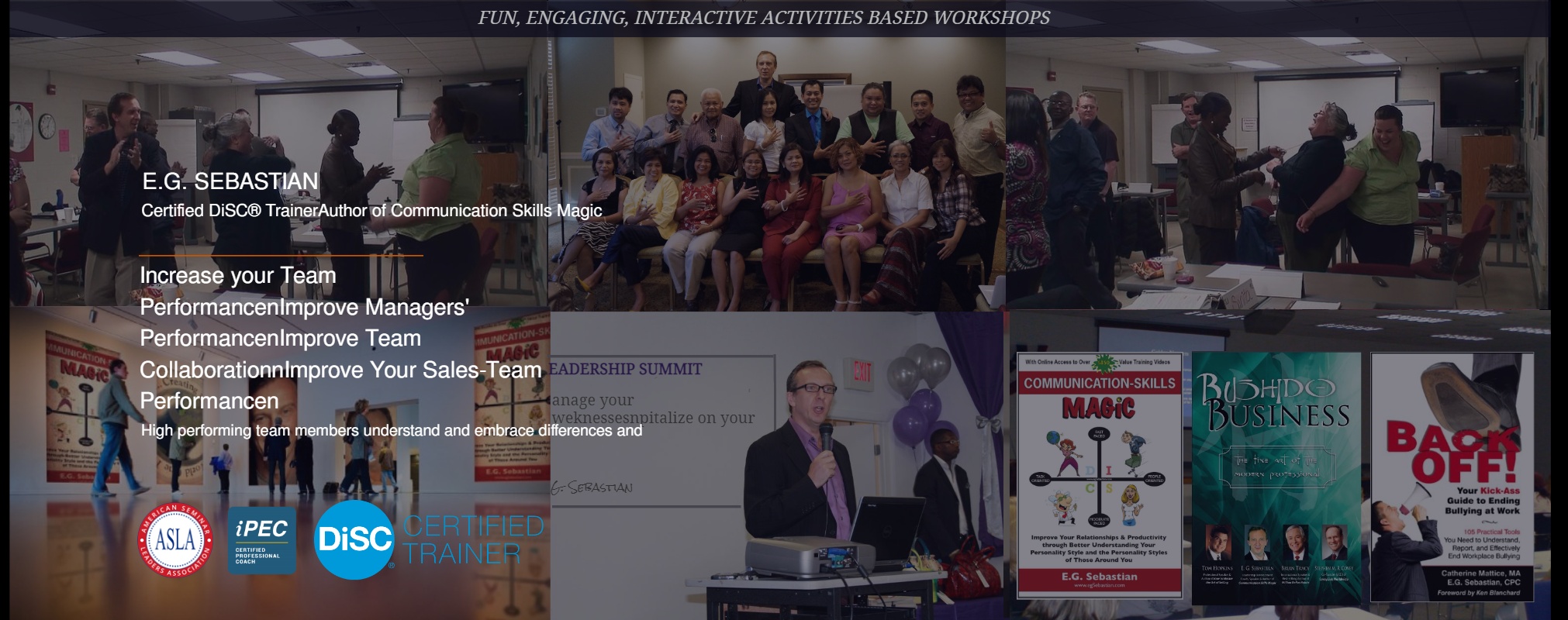
E.G. Sebastian is a leadership & relationship development coach and an international speaker (speaks 6 languages).
E.G. is a certified DiSC Behavioral System trainer and DiSC personality assessments distributor.
Read more tips on Public Speaking at http://www.PaidSpeaker101.com .
Invite E.G. to provide Public Speaking/Presentation Skills training – for groups or for individuals!  Call him toll-free at   877.379.3793 , or contact him by E-mail at eg[at]egsebastian.com.


…..
You may reprint this article in your publication, as long as you publish it in its entirity, including the author bi-line.


Looking forward to ready your thoughts (below):

#1 Key to Effective Communication: Understand Yourself

“Understand tyself!” has been a leading wisdom for thousands of years, both in helping us grow as individuals (self-esteem, finding purpose, etc.), as well as in helping us create better relationships; for it is impossible to communicate effectively with those around you and maintain healthy relationships if you do not understand yourself – why do you behave as you do and why do you communicate as you do?Here’s an excerpts from my book (Communication Skills Magic), highlighting the importance of self-knowledge:
(Do understand that the concept of 4 personality/communication styles is based 100% on hundreds of years of science, with more empirical research done in the past decades on 100s of thousands of individuals, which resulted in creation of valid and reliable personality style assessments, such as the DiSC 2.0, DiSC PPSS, and many more…)
 

Sun Tsu (circa 544 -496 AD) in his timeless military strategy book ‘The Art of War’ said:  so it is said that if you know your enemies and know yourself, you will not be imperiled in a hundred battles; if you do not know your enemies but do know yourself, you will win one and lose one; if you do not know your enemies nor yourself, you will be imperiled in every single battle.  [Sun Tzu, The Art of War. Shambhala, 2005]

Sun Tsu’s teachings on the value of knowing one’s enemy and self are entirely transferable to our relationships. And while we (hopefully) can’t call the other party in any of our relationships “enemy,” they can easily turn into something similar to an enemy if we don’t have a basic understanding of why we do what we do and why the other person behaves as he or she does.

Hence, Sun Tsu’s teaching translated into “relationship language” would be: If you understand the behavior those around you and understand your own behavior, you will avoid hundreds of conflicts; if you do not understand others but do know yourself, you will avoid some conflict and get drawn into some; if you do not understand others’ behaviors nor yours, you are doomed to spend most of your life in conflict and miscommunication.

Many participants in my seminars say that (one of) the greatest benefit they get from participating in my DISC presentation was primarily the better understanding of themselves – the realization that It is OK to be who I am – I am “normal, and this realization leads to a great sense of inner piece and self-acceptance. In many cases, this self-acceptance results in instant higher confidence levels due to understanding that there’s nothing wrong with me – I am not broken.

[Through understanding thes concepts layed out in the book, you] become more aware of your strengths and learn how you can capitalize on them; as well as get to face some of your weaknesses and learn to better accept them or use this new knowledge to work towards improving some weaker areas.


So, let’s get started and find out, first of all, what is YOUR behavioral/personality style; which, in turn, will help you get a better understanding of your behavioral tendencies and communication style.

Take a few minutes now to review a brief description of the four styles, and check the one that you feel describes you most closely.


_____ Dominance (D) Style (Fast Paced/Task Oriented )

D style individuals are characterized by fast pace, fast rate of speech, a strong desire of being in charge, and are highly focused on accomplishing goals and completing tasks. On the job, they are the ones who lead by example, while also will push everyone to perform and leave little room for personal chit-chat. They know what they want, they go for it, and they expect those around them to do the same. D style individuals are goaloriented, process driven, and often turn out to become real achievers. At times, due to their drive to accomplish goals and their high focus to complete the tasks they work on, they are perceived as cold, pushy, inpatient, and as having little consideration for the feelings of those around them. D’s try to avoid, whenever possible, routine work, and environments where they are not given the freedom to be in charge (at least) of their own actions, and are not allowed to move at their own (fast) pace. (See a more detailed description of the D – Dominance Style – in Chapter 4)


_____ Influence (I) Style
(Fast Paced/People Oriented)  

High I style individuals are characterized by fast pace – both in actions and speech – and a love to socialize. I style individuals are easily recognized by their high energy levels, enthusiasm, and their openness to interaction with others at any moment of the day. They tend to almost constantly smile and be ready to share a joke, a (humorous) story, or listen to others’ stories (even though, listening is not their main strength – they rather talk than listen). They come across as friendly, enthusiastic, and passionate; and at times can be perceived as fake (too much smiling and enthusiasm) and tiring (too much talking).  I’s style individuals dislike environments where they are not given the freedom to interact with others, have to perform routine and detail-oriented activities, or are not given a chance for quick and regular recognition.  (See a more detailed description of the I – Influence Style – in Chapter 5) 


_____ Steadiness (S) Style (Moderate Paced/People Oriented)


High S style individuals are characterized by being moderate paced – both in speech rate and physical movement – and by a strong tendency to support others. S style individuals enjoy being around people, and due to their tendency of being more thoughtful and caring, they are great listeners and come across as friendly and warm. S style people are calm, amiable, and supportive.  They are perceived by many to be the sweetest people in the world and most of us enjoy having them around us.  Due to their calm, cautious, and hesitant nature, at times they can come across as being a bit slow at performing certain tasks and slow at making decisions.


S style individuals will often try to avoid fast-paced environments with unpredictable work schedules, and will stay away as much as possible from any situations where they would have to put up with regular conflict or otherwise stressful situations.. (See a more detailed description of the S – Steadiness Style – in Chapter 6)


_____ Conscientiousness (C) Style (Moderate Paced/Task Oriented)


 High C Style individuals are characterized by being cautious, moderate paced, and highly task oriented. C style individuals enjoy working individually or with a small group of other C style individuals.  They like getting deeply involved in performing tasks and do not like to be interrupted while working. They tend to be very particular about doing an excellent job and are very organized. Due to their natural tendency to be analytical and questioning, C style individuals are great in any area where accuracy and precision is needed.  To the other three styles, C style individuals can at times come across as distant, perfectionist, and overly nit-picky.


 C style individuals will try to avoid fast-paced environments where they’d have to make quick decisions, spend most of their time on social niceties, and where they would have no time to plan carefully their days.  (See a more detailed description of the C – Conscientiousness Style – in Chapter 7)


Important!

The DISC Behavioral Model does not suggest that we are stuck in one behavioral style or another (!).  It is designed to raise awareness of our behavioral tendencies; then use this knowledge to take control – or gain acceptance – of our weaknesses and limitations, while focusing on capitalizing on our strengths.”


 To get started creating more successful relationships, Click Here! – Paper Back 
(with instant download of the eBook version)

 To get started creating more successful relationships, Click Here! - eBook


Got any questions regarding the above info? All questions will be answered!

Welcome to Communication Skills Magic

The quality of your life is directly dependent on your ability to communicate and get allong with those around you… And while you think that “I’m fine – it’s all these nut-jobs that need some help,” trust me, we all can use some “help.”

When I say “help,” I simply mean that we all need to become familiar with “WHY do I behave and communicate the way I do?” Perception IS reality, and we all perceive the world around us and others’ behaviors through the lense of our personality styles.

ONLY by understanding this “lense” – by understanding, first of all, our personality style – can we begin to truly understand why some of our relationships are great, and why we just can’t seem to see eye to eye with others…

“Know thyself!” – these words were inscribed on the front gate of the Temple of Apolo in ancient Greece; and they’ve been one of the words containing the highest wisdom for centuries… for only through understanding ourselves can we truly attain self-growth, self-esteem, self-respect, confidence… and as a result the ability to look others in their eyes and communicate with ease…

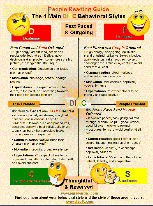
I gotta run, but I’ll be back next time to chat about why is it important to understand others’ personality styles. Meanwhile, make sure to download your People Reading Guide on the top right side of this site…

Do you find this useful? How? Please share below: